Casper Wang 12/4/2020
Augmented reality has increasingly introduced new possibilities for teaching and learning. The coexistence of virtual objects and real environments allows learners to visualise complex spatial relationships and abstract concepts (Arvanitis et al., 2007), experience phenomena that is not possible in the real world (Klopfer & Squire, 2008), interact with 2D & 3D synthetic objects in the mixed reality ( Kerawalla, Luckin, Seljeflot, & Woolard, 2006), and develop important practices and literacies that other technology-enhanced learning environments cannot develop and enact (Squire & Jan, 2007; Squire & Klopfer, 2007; Wu, Lee & Liang, 2013).
One such AR application that we have used is ‘ZapWorks’. It requires a user (or teacher) to create an augment reality experience that allows other users (or students) to scan the ‘ZapWork code’ with their mobile devices to experience AR. The creation of the AR experience is done through the website ‘ZapWorks’ designer tool section. You can upload an image which acts as the background to the augment reality and add overlays, videos text and even other images to the palette. Once the completed code has been scanned by a mobile device with the ZapWorks apps, the overlays can be brought up over the background image and users can experience the augment reality.

Furthermore, the initial interface for and user experience when designing an AR within ZapWorks was a little less friendly upon first impressions. However, the website does provide a tutorial video when you begin designing. Once you begin designing, you can upload an image which triggers the AR, this can be an image that students can have easy access to or is essential for them. It could take the form of an A4 piece of paper with the background image already on it.
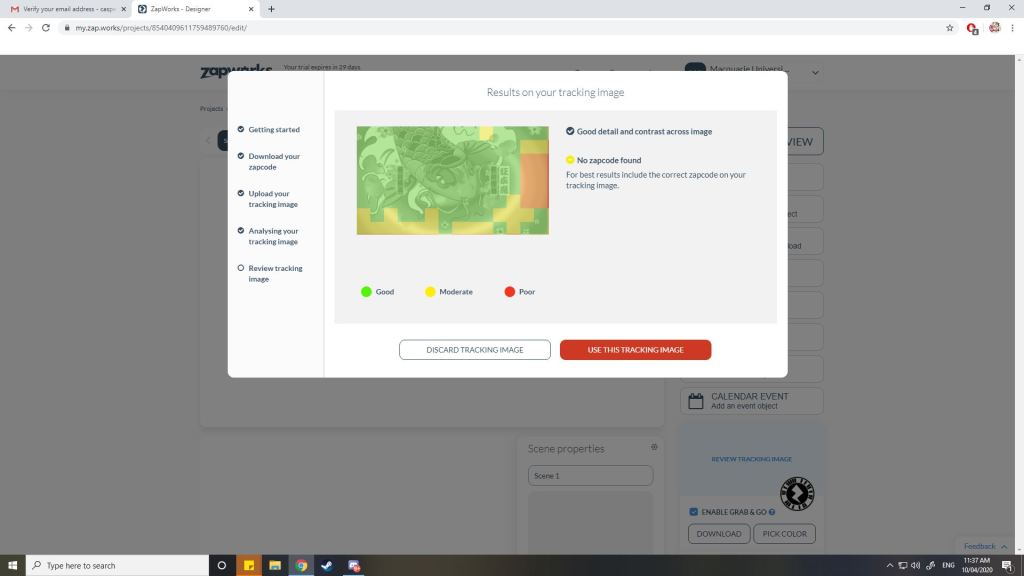
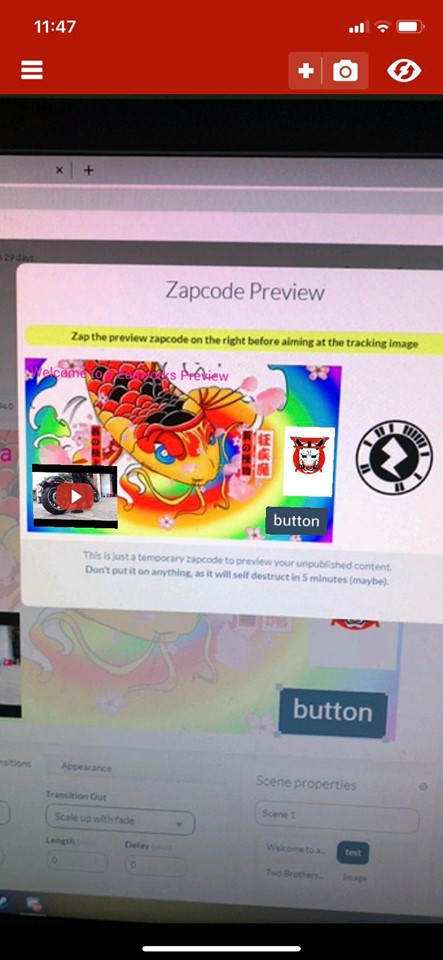
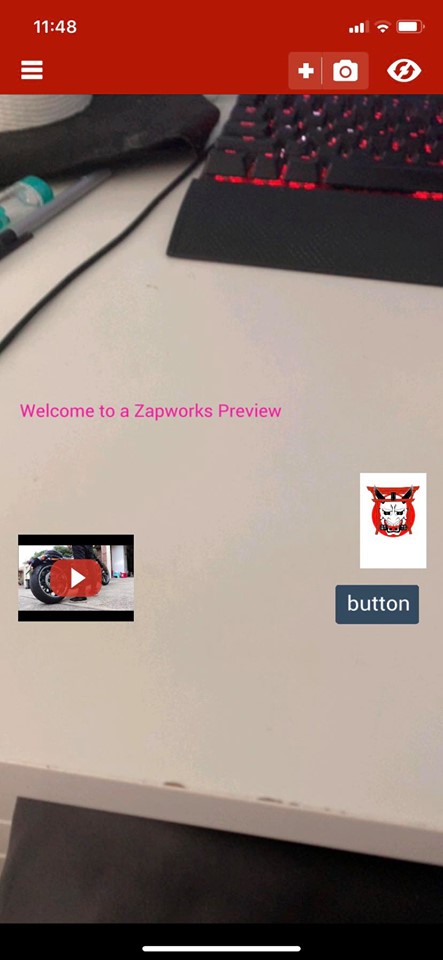
Image 4 Right: the overlays still appear on the screen even though the camera has moved away from the background image.
However, pedagogical issues should be taken into consideration when AR systems are implemented in classrooms. The use of AR systems may encounter constraints from schools and rejection among teachers. The nature of AR learning activities involves instructional approaches (participatory simulations and studio-based pedagogy) are quite different from the traditional teacher centred teaching methods (Kerawalla et al., 2006; Mitchell, 2011; Squire & Jan, 2007). Another issue involves how should the information be distributed and utilised between two realities and different devices (Wu et al., 2013). A set of design guidelines based on learning theories and empirical evidence would be useful to counteract this issue.
References:
Arvanitis, T. N., Petrou, A., Knight, J. F., Savas, S., Sotiriou, S., Gargalakos, M., et al. (2007). Human factors and qualitative pedagogical evaluation of a mobile augmented reality system for science education used by learners with physical disabilities. Personal and Ubiquitous Computing, 13(3), 243–250. http://dx.doi.org/10.1007/s00779-007-0187-7.
Kerawalla, L., Luckin, R., Seljeflot, S., & Woolard, A. (2006). “Making it real”: exploring the potential of augmented reality for teaching primary school science. Virtual Reality,10(3), 163–174.
Klopfer, E., & Squire, K. (2008). Environmental detectives: the development of an augmented reality platform for environmental simulations. Educational Technology Researchand Development, 56(2), 203–228. http://dx.doi.org/10.1007/s11423-007-9037-6.
Mitchell, R. (2011). Alien contact!: exploring teacher implementation of an augmented reality curricular unit. Journal of Computers in Mathematics and Science Teaching, 30(3),271–302.
Squire, K., & Jan, M. (2007). Mad city mystery: developing scientific argumentation skills with a place-based augmented reality game on handheld computers. Journal of Science Education and Technology, 16(1), 5–29. http://dx.doi.org/10.1007/s10956-006-9037-z.
Squire, K., & Klopfer, E. (2007). Augmented reality simulations on handheld computers. Journal of the Learning Sciences, 16(3), 371–413. http://dx.doi.org/10.1080/10508400701413435.
Wu, H.K., Lee, S.W.Y., Chang, H.Y. & Liang, H.C. (2013). Current Status, opportunities and challenges of augmented reality in education. Computers & Education. 62, 41-49.
 EDUC3620 Digital Creativity and Learning - CW
Hi Casper,
I really appreciated your observations about Zapworks being initially confusing for the user. I had the same issues, but found the tutorial videos and experimentation helped a lot, and after a while, the software made sense. I found the process reminded me considerably of design-based thinking because I had to test the AR I created a lot to properly determine different functions and usability. This definitely links with your comments about teachers rejecting AR as well, as I can imagine the time spent to familiarise with the program might hinder many.
LikeLike